
Last Updated on February 28, 2026
Rachel Roddy’s paean to pasta.
The legions of Rachel Roddy fans have been waiting with excited anticipation for her newly published An A – Z of Pasta (Penguin, Fig Tree). Renowned as an award-winning food writer and columnist in The Guardian, she has garnered a loyal following. Subtitled, stories, shapes, sauces, recipes, this is Roddy’s paean to pasta. The book runs to over 300 pages and is filled with 50 essays about Italian culture, history and cuisine, each ending with a recipe. It is both a fascinating read and a great resource for the kitchen. While Roddy includes instructions on how to make egg pasta as well as flour and water dough, this book ultimately provides inspiration to readers on how to eat pasta, whether fresh or dried.

What I most enjoyed about An A-Z of Pasta was how down-to-earth it is. I expected it might be because, in her weekly column, Roddy has a chatty, accessible tone and a great talent for sharing a food story. Open the book on any page, get into the kitchen, and you are guaranteed a delicious meal. It is unlikely to be fancy – there are many recipes for pasta with lentils, beans, tuna, tomatoes and other everyday ingredients – this is home cooking, not restaurant fare. This is why the book is so useful and a good addition to the bookshelf. I have many Italian cookbooks, some of which are written by famous chefs with award-winning restaurants, but the ones I come back to again and again are those where I feel that the meal I am eating is food as cooked by my grandmother – well, if she had been Italian. Roddy herself is not Italian but has lived in Rome for sixteen years, where she has learnt about the making and eating of pasta.
Roddy provides recipes to suit all the pasta shapes she writes about from A – Z but I doubt she is going to be too upset if one chops and changes according to what is in the cupboard. I chuckled at her description of pasta sauces as polygamists, pairing happily with many shapes. That said, certain shapes and sauces do enhance the dish when dancing together on the plate. Roddy writes that the history of pasta is the history of Italy. With between 350 and 600 shapes and 1300 dialect names, that is a complex history. Roddy describes pasta shapes as ‘edible hubs of information: flour and liquid microchips containing huge amounts of data, historical, geographical, political, cultural, personal, practical.’ Roddy explores the history of pasta, which begins 12,000 years ago in Mesopotamia, where crops were first domesticated and from where they spread across the world, wheat settling as the staple crop in the Mediterranean.
Unless readers have a very well-stocked pasta aisle in their local supermarket or travel widely in Italy, it is likely that most people will learn a fair amount from Roddy’s alphabetical tour through the pasta shapes. Only a few letters in, and I had already encountered shapes I had never heard of, let alone cooked with. I have never been tempted to make my own pasta, being intimidated by the process and being rather lazy I suppose. The photographs, by Jonathan Lovekin, in which Roddy makes fresh cappellacci has brought me closer to investing in a pasta machine or trying hand-rolled pasta shapes. I suspect that, much like making bread, once the technique is mastered, even at an elementary level, the habit may bite. In the meantime, I made do with factory-produced pasta and got cooking.

Many years ago, when my adult children were mere bambini, we holidayed in Liguria over a hot summer fortnight. They discovered a passion for trofie con pesto – a signature dish of the region where hillsides are fragrant with basil. Before we left for home, I filled my suitcase with packets of these spindly pasta shapes. Later, I discovered that trofie could be found in London, and I made the dish repeatedly over the years. It wasn’t until I read the recipe in An A – Z of Pasta that I realised I was not making trofie alla Genovese, never having added cubes of potato to the cooking water. I lost no time in doing so and happily served it up for dinner. As I dished up, the rain came down on a summer evening, which is just one difference between cooking pasta in the UK and Italy. The basil seemed less intense in flavour, which renders the pesto less intense – there are some Italian restaurants that import their basil from Liguria for good reason. At least I had no mosquitoes tormenting me.
A few nights later, I tried a very simple dish of brown lentils and orecchiette – little ear-shaped pasta that hail from Puglia. This was the epitome of a store cupboard dish, cooked very quickly, and provided hearty fare. ‘Steady and good’, as Roddy describes it. Despite it being such a low-key dish, I received compliments at the table. Honest, good food.

Another simple dish was linguine con zucchine, uova e parmigiano. The courgettes have to be sliced very thin so that they are about the same thickness as a strand of linguini. Once a bit of meditative slicing was over I was ready to cook. Then it was a simple matter of frying the sliced onions and courgettes and cooking the linguini. While this bubbled away, the eggs were whisked along with grated Parmesan and seasoning. The cooked pasta was added to the cooked vegetables, after which the egg mixture was swirled through. The result was a creamy sauce which we ate with a crunchy green salad. The evening sun shone, and the gentle sound of slurping surrounded us.

Continuing my trip down memory lane, I tried my hand at a puttanesca sauce, which I served with tagliatelle. This was the first pasta sauce my husband made for me when we were dating, and he has cooked it many times since. That is one of the things I love about a book about cooking pasta. Because we have all done so – or at least eaten pasta cooked for us, even if in a restaurant – each sauce carries its own personal memories. When I make puttanesca, I usually do so from memory, but this time I followed Roddy’s instructions to the letter, and needless to say, it was the best I have ever made. Firstly, she uses more olive oil than I do, which, I realised when swirling in the cooked pasta, is an essential part of its success. I have finally realised the importance of adding the cooked pasta to the sauce, giving the pan a very good swirl so that every strand is well coated in the sauce, which has a deep umami flavour from the anchovies. I recalled one of her essays about the history of anchovies in Italian cuisine and the garam sauce made in the days of Pompeii.

The one issue that Roddy does not address in An A-Z of Pasta is wholewheat pasta. Perhaps she feels that this is too much of a transgression against the beauty of the silkiness of pasta. When my children were very young and first began to eat pasta, I made the decision to raise them eating it in wholewheat form. I have always felt slightly conflicted about it because, while wholewheat flour is a healthier option, it is not as tasty in my view. Over the past two decades, a greater number of wholewheat shapes have come into the supermarkets, but even now I still serve white flour pasta on special occasions or as a treat. That said, I tried some of these recipes with whole-wheat pasta, and they tasted great as the sauces are really good.
An A-Z of Pasta is a book rich with recipes and dense with information and footnotes that require my attention. It is a volume to be savoured like the wines Roddy suggests enjoying while onions are slowly cooking down into a creamy consistency for bugoli in salsa (onion and anchovy). This year I am taking this book on my family holiday. As we will be at the coast, I am going to be making Roddy’s vermicelli with calms and scialatielli Amalfi style with shellfish, squid, tomatoes and breadcrumbs. It will transport us from a possibly damp UK to the heat of southern Europe.
An A-Z of Pasta is not only immensely user-friendly and practical, it is also a labour of love about a niche subject. It will fill any foodie friend’s heart with joy should you be thinking of a special gift, perhaps along with a pasta maker, or a few packets of lesser-known shapes, a good bottle of extra-virgin olive oil and a pot of basil.
Meanwhile, here’s her recipe for Vermicelli alla Puttanesca so you can try at home. It’s one of my favourite pasta dishes – despite the claimed heritage that it was a sauce invented by prostitutes – with the aim of luring in customers thanks to its powerful aroma! designed to lure customers with its powerful aroma
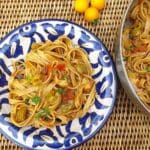
Vermicelli alla puttanesca
Ingredients
- 100 ml olive oil
- 1-3 cloves garlic crushed or sliced
- 1 pinch red chilli flakes
- 4 – 8 anchovy fillets
- 2 tbsp capers
- 2 tbsp black olives
- 12 cherry tomatoes quartered or crushed
- 1 pinch dried oregano
- 400 grams vermicelli or spaghetti
- handful flat leaf parsley finely chopped
Instructions
- Bring a large pot of water to the boil.
- Using a large frying pan – it will later have the pasta added to it – warm the olive oil with the garlic and red chilli. Then add the anchovy fillets and cook on gentle heat until they dissolve.
- Add the capers and the olives.
- Add the cherry tomatoes and raise the heat, squashing the tomatoes so that the mixture becomes saucy. Cook for approximately 8 minutes.
- While the sauce is cooking, pop the pasta into the boiling water. Cook according to the packet instructions until al-dente.
- Now you can either drain the pasta or lift it straight out of the boiling water and into the pan with the sauce using tongs or a spider sieve.
- Add the parsley and then swirl it all together so that all the strands of pasta are coated with sauce.

Leave a Reply